Alabama Life Jacket Rules for Kids: Under Eight and Under Way
If you’re boating with a young child in Alabama, it can be easy to assume a life jacket is needed only when the boat is moving or the water looks rough. The rule is broader: children under eight must wear an approved life jacket while aboard, with a limited enclosed-cabin exception. Here’s how to understand that rule, choose a usable jacket and make it part of your routine.
Alabama’s rule for children under eight
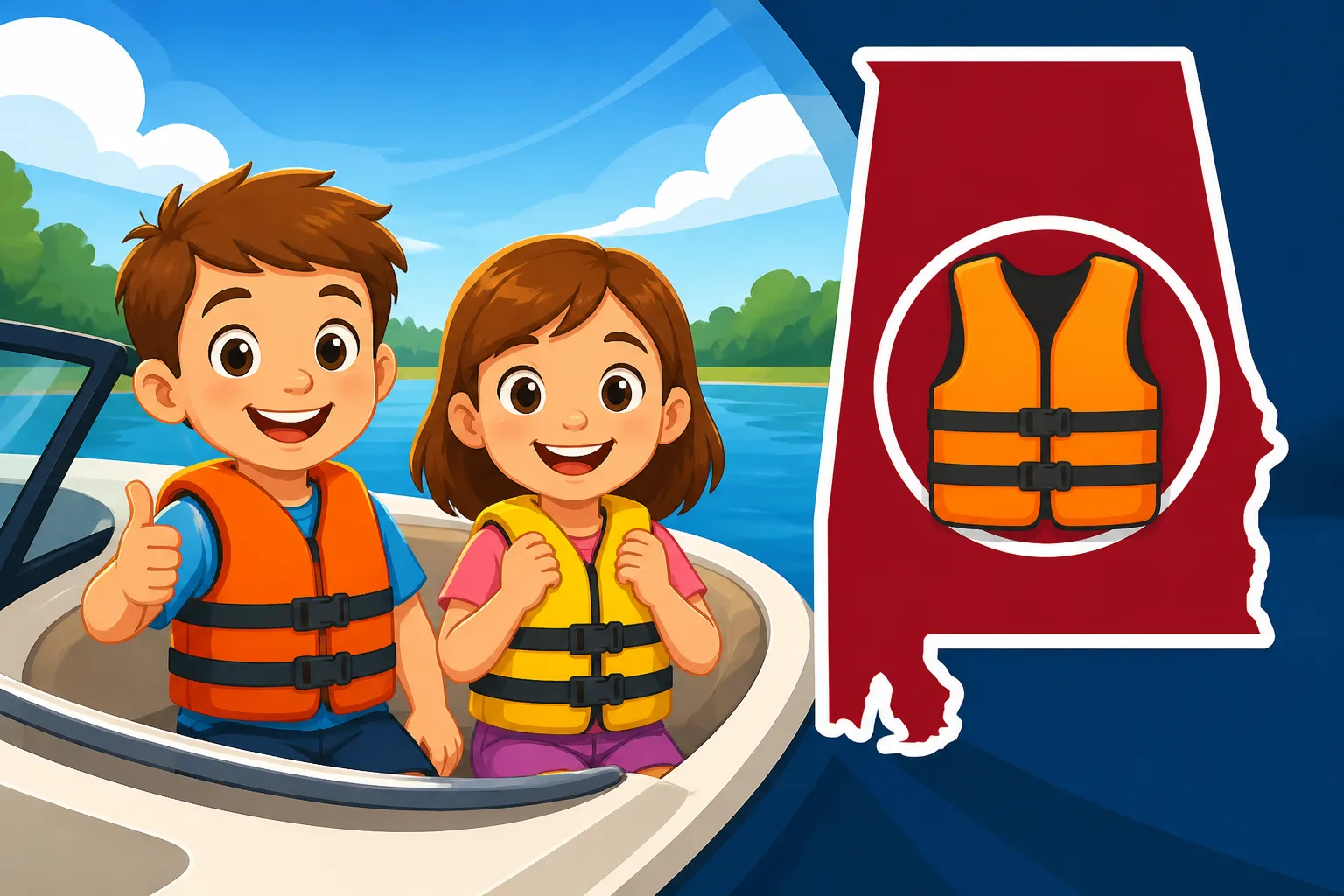
Alabama requires a child under eight years old to wear a Coast Guard-approved personal flotation device, or PFD, at all times while on board a boat. The stated exception is when the child is inside an enclosed cabin or sleeping area. This is not a rule limited to cruising speed, open water or rough conditions.
That distinction matters at the dock as well as underway. A child on deck while the boat is tied up is still on board. So is a child moving around while the boat is idling, waiting to leave a launch area or drifting at anchor. If the child is outside the qualifying enclosed space, the safest way to follow the rule is to have the approved PFD on and worn properly.
A jacket resting beside the child, tucked under a seat or stored in a compartment is not being worn. Nor does a child’s confidence in the water change the requirement. Swimming ability, an adult’s close attention and a calm day are not substitutes for the PFD.
| Situation | What to do |
|---|---|
| Child under eight is on deck or elsewhere outside an enclosed cabin | Have the child wear a Coast Guard-approved PFD |
| Boat is moving, idling, anchored or tied up | Keep the PFD on if the child is aboard and outside the exception |
| Child is inside an enclosed cabin or sleeping area | The stated exception applies; consider whether the child can reach the exit and respond safely |
| The jacket is nearby but not on the child | Put it on before the child is on board outside the exception |
| You are unsure whether a space qualifies as enclosed | Do not rely on a guess; keep the PFD on and check the official guidance |
The exception should not be stretched to cover any place with a roof or any area where a child happens to sit. If your boat has a cabin, think about whether it is actually enclosed and whether the child is inside it, rather than on an open deck, in a cockpit or on a seat beneath a canopy. When there is doubt, leaving the PFD on is the more straightforward choice.
For a closer look at the wording and practical limits of that exception, see Cabin Exception: When Under-Eights Can Take Life Jackets Off. The broader requirement is also covered in What Alabama Requires for Children and Life Jackets on Board and Alabama Life Jacket Laws for Every Boat and Every Rider.
What “at all times” means on a real boat day
A family boating day has many moments when nobody thinks of the trip as “underway”: loading bags, stepping from the dock, easing away from the ramp, stopping to swim, tying up for lunch and returning to shore. The child’s PFD should be part of each transition, not something an adult remembers only after the boat reaches open water.
A useful rule of thumb is to have the child wear the jacket before boarding and keep it on whenever the child is outside the enclosed-cabin exception. That makes the routine easier to follow and reduces the chance that the jacket is left behind during a quick move. It also avoids confusion when a boat changes from stationary to moving.
The rule applies regardless of whether the boat is a family runabout, a pontoon, a fishing boat or a rented vessel. A child’s life jacket should not be treated as an optional extra that depends on the activity. If a trip includes time on the water, plan for the child to wear the PFD during the portions of the trip when the child is aboard and outside the exception.
At the dock and during boarding
Before the child steps aboard, check that the PFD is on, fastened and adjusted. A dock can be slippery, a boat can shift, and a child can lose balance while stepping across a gap. The jacket does not prevent every accident, but wearing it before boarding avoids an exposed moment while an adult searches for gear or tries to fasten it in a crowded cockpit.
If several adults are helping, decide who is responsible for the child’s jacket. It is easy for each person to assume another adult has checked. A simple verbal handoff—“The jacket is on and fitted”—can prevent that gap without turning the launch into a complicated checklist.
While the boat is moving
Keep the PFD on for the whole time the child is outside the qualifying enclosed space. A calm ride, a familiar lake or a short run close to shore does not create a different rule. In practice, children may stand, lean or move suddenly, and the boat may encounter wake or an unexpected change in speed.
Set the expectation before leaving: the jacket stays on outside the cabin. That is easier for a child to understand than a changing set of exceptions based on speed, distance from shore or who is steering.
During swimming and stops
A stop for swimming does not mean a child should be left without a PFD while still aboard outside the enclosed-cabin exception. If the child enters the water, follow safe swimming practices and keep a suitable PFD close at hand for the return to the boat. Before the child climbs aboard, put the worn jacket back on.
At a beach or dock, keep the boat-day routine clear. The child can take the jacket off only when no longer subject to the onboard requirement, or when inside the stated exception. Avoid placing a wet jacket in a pile where it may be difficult to find when everyone is ready to leave.
While anchored, tied up or waiting
A stationary boat can still rock, drift or be affected by passing wakes. Children may also move around more freely when adults are focused on food, fishing gear or a conversation. Keep the PFD on outside the exception during these quieter stretches too.
That includes waiting at a launch, rafting near another boat or stopping at a dock-and-dine location. The boat does not have to be traveling for a child to be at risk of falling overboard.
Choosing a PFD a child can wear properly
The law calls for a Coast Guard-approved PFD, but an approval label alone does not guarantee the jacket is a good fit for a particular child. A jacket that is too large can ride up; one that is too small may be uncomfortable or difficult to fasten. The child needs a PFD that matches their current size and can be secured correctly.
Start by checking the label and the manufacturer’s fit guidance. Follow the stated weight or size range, and inspect the jacket for damage, missing parts, broken fasteners, torn fabric or signs that it has been stored poorly. If you are not sure how it should fit, ask a knowledgeable retailer or boating-safety professional to help you check it. West Marine is one place families may look at options and ask questions, but the label and manufacturer instructions for the specific jacket are what matter.
Fit the jacket to the child, not the boat
A life jacket bought for a growing child can become too small before the next season. Recheck fit whenever the child has grown, whenever the jacket is passed down from another child and before a trip after long-term storage. Do not rely only on how the jacket looked when it was purchased.
Have the child wear the jacket over the kind of clothing they are likely to wear on the boat. Fasten every closure as directed, tighten the straps and check that the jacket stays in place when the child moves. The fit should be secure without being painful or restricting normal movement.
If the jacket shifts noticeably, rides up or leaves the child struggling to move, stop and reassess the size and adjustment. A child who can pull the jacket off easily, or who keeps trying to remove it because it pinches or rubs, may need a different model or a better fit. Do not solve a comfort problem by leaving the jacket unfastened.
Let the child practice before the trip
Introduce the jacket at home or on shore before the boat day. Show the child how it fastens, explain that it stays on outside the cabin and let them move around in it briefly. This helps identify a scratchy edge, an uncomfortable strap or a fit problem before the boat is crowded and everyone is ready to leave.
Practice should not be presented as a way to test whether the child can swim in the jacket. The point is to make wearing it familiar and to give the adult a chance to check the fit. A PFD is safety equipment, not a toy or proof that a child can safely enter the water.
If you are shopping in person, bring the child along and compare options by fit and comfort rather than appearance alone. A child may be more willing to keep a jacket on if it feels comfortable, but preference does not replace approval or correct fastening. Keep the product label and instructions available so you can check the intended use and care requirements.
For a broader fit checklist, read Does Your Life Jacket Fit? Condition and Fit Checks on Alabama Boats. If the child will ride on a personal watercraft or be towed behind a boat, check the activity-specific guidance as well, including Jet Ski Life Jacket Rules in Alabama: Riders and Towed Passengers and Tubing or Skiing in Alabama? Everyone Being Towed Wears a Life Jacket.
Making the rule easy to follow with children
A legal requirement is easier to meet when the family has a repeatable routine. Decide where the child puts the jacket on, where it stays when not being worn and who checks it before departure. That way, the decision does not have to be made from scratch at every dock or stop.
A simple routine can look like this:
- Choose the child’s approved PFD before loading the boat.
- Put it on and fasten it before the child boards.
- Check the fit and closures.
- Keep it on whenever the child is aboard outside the enclosed-cabin exception.
- Recheck it after swimming, changing clothes or moving between the boat and shore.
- At the end of the trip, inspect the jacket, let it dry as directed and store it where it can be found next time.
For young children, adults should handle the final fit check. A child may say the jacket is fastened when a buckle is open or a strap is loose. Teach the child to speak up if the jacket feels uncomfortable, but do not make the child solely responsible for deciding whether it is secure.
Make the expectation consistent
Children are more likely to accept a rule that stays the same. If the PFD comes off whenever the boat is slow, the child may assume it can also come off while idling, anchored or moving through a no-wake area. A consistent message is simpler: outside the enclosed cabin, the jacket stays on while aboard.
Adults can reinforce the routine by wearing their own PFDs when appropriate and by avoiding jokes or arguments about the child’s jacket. If the child complains, check the fit and make a reasonable adjustment. If the jacket is uncomfortable because it is the wrong size or style, solve that problem before the next outing rather than making an exception on the water.
Assign a responsible adult
On a boat with several adults, name one person to confirm that the child has a properly worn PFD. This does not mean other adults stop paying attention. It means the task has a clear owner, especially during busy moments such as loading, docking or changing passengers.
The responsible adult should also know where the child is while the boat is moving and during stops. A jacket is an important layer of protection, not a replacement for supervision. Keep the child within an adult’s attention and avoid letting the jacket create a false sense that the child can be left alone.
Plan for a rented boat
When renting, do not assume the PFDs provided will fit every child in your group. Ask the operator in advance what child-sized options are available and whether you may bring your own approved jacket. Inspect any supplied PFD before leaving the dock, and confirm that it fits and fastens properly. If it does not, address the problem before the trip begins.
Rental paperwork and operator instructions do not replace Alabama’s requirement. An adult still needs to make sure the child is wearing the right PFD in the required situations. If you are new to boating, Alabama Boat Rental Safety: Life Jackets, Age and Equipment offers a useful broader checklist, and Questions to Ask a Rental Operator Before You Book in Alabama can help you prepare questions before arriving.
Common misunderstandings to avoid
Some mistakes come from treating the requirement as a general suggestion rather than a specific rule for young children. Others come from confusing a jacket being carried with one being worn. These are the points worth checking before every trip.
“The boat is not moving, so the jacket can come off”
The requirement is not limited to when the boat is underway. A child under eight must wear an approved PFD at all times while aboard unless inside an enclosed cabin or sleeping area. Being tied to a dock or stopped at anchor does not, by itself, create an exception.
“The child is a strong swimmer”
Swimming ability does not cancel the requirement. Even a confident swimmer can fall unexpectedly, become disoriented or be separated from an adult. The rule applies to children under eight regardless of skill.
“The jacket is within reach”
Having a jacket in the boat is not the same as having it on the child. A jacket that is stored under a seat or held by an adult does not meet a requirement to wear it. Put it on and fasten it properly before the child is outside the exception.
“Any vest will do”
The rule specifies a Coast Guard-approved PFD. Do not assume a novelty vest, swim aid or unapproved flotation item counts. Check the product marking and instructions. The jacket should also fit the child and be in usable condition.
“A canopy makes the area an enclosed cabin”
A bimini top, sunshade or other overhead cover may offer shade, but that does not necessarily make the space an enclosed cabin. If the child is in an open cockpit or on an exposed deck, keep the PFD on. When the boat’s layout makes the exception unclear, do not rely on an informal interpretation.
“The child can take it off for just a moment”
Quick transitions are exactly when routines can break down: stepping onto a dock, moving to another seat, taking a swim break or grabbing something from a cooler. Keep the jacket on outside the exception rather than trying to judge whether a brief moment is safe enough.
A practical pre-departure check
Before leaving the ramp or dock, pause long enough to look at the child’s PFD rather than asking from across the boat whether it is on. Check that the label shows it is Coast Guard-approved, that it is intended for the child’s size and that all fasteners are secured as instructed. Make sure the jacket is not twisted, loose or riding up.
Then agree on the cabin rule and the adult responsible for supervision. If the child will be inside an enclosed cabin, confirm that the space really fits the exception and that an adult can still keep track of the child. If the child will come back onto the deck, the PFD should be on again before they do.
For families who want to learn more about general boating safety, a course can help explain how life jackets fit into a wider safety plan. BoaterExam may be one option to explore for boating education, but choosing a course does not replace the need to follow the PFD rule on the water. For the rule and related Alabama requirements, see Alabama Life Jacket Rules for Kids: Under Eight and Under Way—and make sure the jacket itself is ready before the trip.
The most reliable approach is uncomplicated: select an approved, well-fitting PFD; have the child wear it whenever they are aboard outside the stated exception; and keep an adult responsible for checking. It is easier to follow one consistent routine than to decide anew at every stop whether a child needs a jacket.
Sources
- Alabama Law Enforcement Agency — Boat Equipment Checklist For Alabama | Alabama Law Enforcement Agency (checked November 5, 2026)
- Alabama Law Enforcement Agency — Boating Rules and Regulations | Alabama Law Enforcement Agency (checked November 5, 2026)
Disclaimer
This article is for general informational purposes only and does not constitute professional advice. Laws, prices and regulations vary by location and change over time. Consult a qualified professional for guidance on your specific situation.